




What The Brush Does Inside a Robotic Rotating Joint
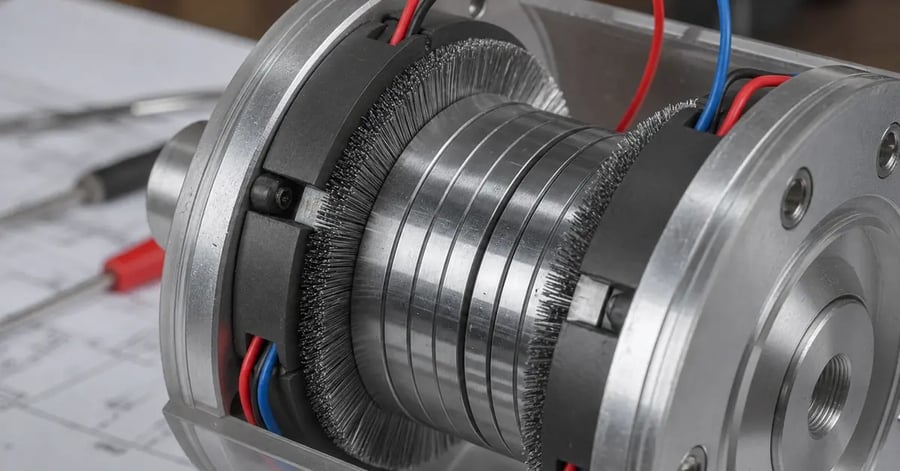
A slip ring lets an electrical circuit pass across a rotating interface like a wrist, rotary table, end-of-arm tool changer, indexing head, or any axis that needs motion without winding cables into a hard stop. The stationary side connects to one part of the machine. The rotating side turns with the axis. The brush maintains sliding electrical contact with the rotating ring so current or signals can cross the boundary.
The brush and ring form a contact pair. Electrical behavior depends on the mating materials, contact pressure, surface finish, current density, speed, heat, contamination, and mechanical alignment. The engineering question is: has the rotating interface been specified with enough detail to survive the robot's real duty cycle?Why Robots Are Harder on Slip Ring Contacts
Most introductions to slip rings use motors, generators, or wind turbines as examples. Those are valid, but they don't capture the packaging and signal challenges common in industrial robots.
A robot joint may have to carry motor power, brake power, encoder feedback, sensor circuits, fieldbus communication, tool power, and safety-related signals through a compact rotating envelope. All this while keeping mass low, protecting cable routing, fitting around bearings or gearboxes, and avoiding service procedures that require disassembling half the axis.
That changes three things about the contact design:
-
Compact packaging: Smaller envelopes increase the sensitivity of the contact design to current density, surface condition, alignment, and debris.
-
Power and data share the interface: A power contact may tolerate conditions a low-level signal contact cannot. If both circuit types pass through the same assembly, the brush system has to be selected with both in mind.
-
Downtime is expensive: Noise, heat, intermittent faults, or unexpected wear extend into troubleshooting time, missed production, and difficult root-cause analysis.
Why Metal and Carbon Graphite Are Used for Sliding Electrical Contact
Metal and carbon graphite combines electrical conductivity with tribological behavior suited to sliding contact. In practical terms, it conducts current while behaving as a self-lubricating material against a compatible mating surface. That combination matters anywhere the contact has to move continuously or repeatedly without external lubrication becoming the main reliability dependency.
Metal graphite and carbon graphite aren’t one material with one behavior. Grade formulation affects conductivity, wear, strength, friction behavior, and compatibility with the ring material. St. Marys Carbon manufactures custom carbon graphite components and works with engineers on the right grade for the application.
With that said, very low-current signal applications, extremely small packages, or specialized high-frequency transmission may point to a different contact approach. When the rotating interface needs durable sliding contact, metal graphite or carbon graphite deserves an early engineering discussion.
Power Circuits and Signal Circuits Ask Different Things
A joint that carries only power is a different design problem from one that carries only sensor signals. Many assemblies need both, and treating those requirements as interchangeable is one of the fastest ways to underspecify the brush system.
| CONDITION | WHAT THE CONTACT MUST PRIORITIZE | BRUSH-SELECTION IMPLICATION |
| POWER-FOCUSED CIRCUITS | Current carrying capacity, heat control, stable mechanical contact | Evaluate grade conductivity, brush geometry, spring force, and thermal behavior as a system. |
| SIGNAL-SENSITIVE CIRCUITS | Low electrical noise, stable contact resistance, clean signal transfer | Prioritize contact stability and material pairing, not conductivity alone. |
| MIXED POWER/ DATA ASSEMBLIES | Separation of requirements within one rotating package | Specify each circuit path deliberately. Don't assume one brush material suits all paths. |
The mixed case is often the real one. The brush used for a higher-current path may not be appropriate for a sensitive feedback circuit. A continuity check tells you whether the circuit closes. It can't tell you whether contact resistance stays stable during rotation, whether electrical noise is acceptable, or whether wear will stay predictable under the real duty cycle.
Brush Material Options
There's no universal "best" material for every brush slip ring design. Carbon graphite, copper-graphite, silver-graphite, and wire-brush contacts all have a place.
| CONTACT APPROACH | WHERE IT MAY FIT | DESIGN CAUTIONS |
| CARBON GRAPHITE | Sliding contact applications where self-lubricating behavior and wear control matter | Must be matched to ring material, loading, current density, and environment. |
| COPPER-GRAPHITE | Applications needing a balance of conductivity and graphite contact behavior | Material pairing and wear behavior still need validation. |
| SILVER-GRAPHITE | Demanding electrical contact needs that justify a more specialized material | Cost, wear strategy, and ring compatibility should be discussed before selection. |
| WIRE-BRUSH CONTACTS | Compact assemblies or designs with multiple fine contact points | Not interchangeable with carbon graphite. Evaluate current, wear, debris, and signal requirements. |
The Brush Can't Fix a Poorly Specified System
The brush is responsible for contact, but it isn't in control of every condition that affects contact. The rest of the assembly helps it succeed or forces it into a failure mode. Here are other variables that deserve attention before design release:
-
Ring material and surface finish: Mismatch changes wear, film formation, and contact stability.
-
Spring force: Too little creates unstable contact and too much increases wear and heat.
-
Current density: Don't assume a smaller brush carries the same duty without consequence.
-
Rotational behavior: Continuous rotation, indexing, oscillation, and frequent starts/stops create different wear patterns.
-
Environment: Dust, debris, humidity, chemical exposure, temperature, and vibration change contact behavior.
-
Maintenance access: A brush that's technically replaceable but buried inside the axis may not be practical for production equipment.
Failure Symptoms That Point Back to the Specification
Slip ring problems often show up as maintenance issues. Replacing the brush and moving on works sometimes. Repeated symptoms usually need a deeper look at the system:
-
Electrical noise can mean unstable contact, contamination, surface issues, vibration, or material mismatch.
-
Intermittent signal loss: especially damaging in feedback or control circuits.
-
Streaking on the ring: uneven contact, contamination, or incompatible surface condition.
-
Grooving: excessive localized wear, poor contact geometry, abrasive debris, or mismatched materials.
-
Uneven brush wear: misalignment, inconsistent loading, vibration, or ring condition.
-
Shrinking replacement interval: the root cause is probably not just normal wear.
-
Heat near the contact: excessive current density, poor contact, too much resistance, or mechanical overloading.
Replacement Brush or Custom-Engineered Contact?
If the existing assembly is proven, the ring is in good condition, and the original grade is known, a replacement is the direct path. Replacement logic breaks down when the original design isn't working, the grade is unknown, or requirements have changed.
-
Replacement brush works when the existing assembly performs well and the goal is restoration.
-
Material substitution is the answer when there's a clear reason to change contact behavior.
-
Choose a custom-engineered contact when envelope, load, signal integrity, wear, environment, or production reliability requires grade and geometry matched to the application.
Pogo pins, PCB contacts, or improvised spring contacts can prove a concept, but they don't automatically translate into production-duty rotating interfaces.
How to Evaluate a Supplier
For robotic slip ring brushes, the better question isn't who can produce a component to print. It's who can help reduce uncertainty before the design is locked. Ask:
-
What grade are you recommending, and why? Should connect to current, signal stability, ring material, speed, environment, and wear expectations.
-
What ring material and surface condition does the recommendation assume? If the brush supplier ignores the ring, the recommendation is incomplete.
-
Can the geometry be adjusted for the assembly? Contact face, lead style, holder fit, and spring arrangement matter.
-
Can samples be provided for validation?
-
What testing or third-party validation can be supported?
-
What lead time should the project plan around?
-
Can the supplier support production after prototype approval?
St. Marys Carbon has manufactured metal graphite and carbon graphite components since 1939 and supports engineered brush and electrical contact applications with in-house manufacturing, proprietary grade development, ITAR registration, AS9100 certification, and ISO 9001 certification.
Talk Through the Contact System Before the Design is Locked
Slip ring brushes do more than complete a circuit. In an industrial robot, they help determine whether rotating power and data transmission stays stable, serviceable, and predictable over the life of the assembly. The safest specification treats the brush, ring, geometry, current path, signal requirement, and environment as one contact system.
If your robotic assembly is still in design, this is the right time to discuss metal graphite or carbon graphite grade options, mating ring assumptions, testing needs, and lead-time planning. If an existing assembly is showing noise, grooving, streaking, or frequent brush replacement, it's time to review the system rather than ordering the same component again.
Talk to a carbon graphite engineer or review our slip ring brushes for your robotic assembly.